
What would it take to ensure that young women, particularly from disadvantaged backgrounds, can fully benefit from the revival of the tourism sector in Cambodia? A recent impact assessment by Rapid Universal for the Sala Baï Hotel School offers timely and powerful insights.
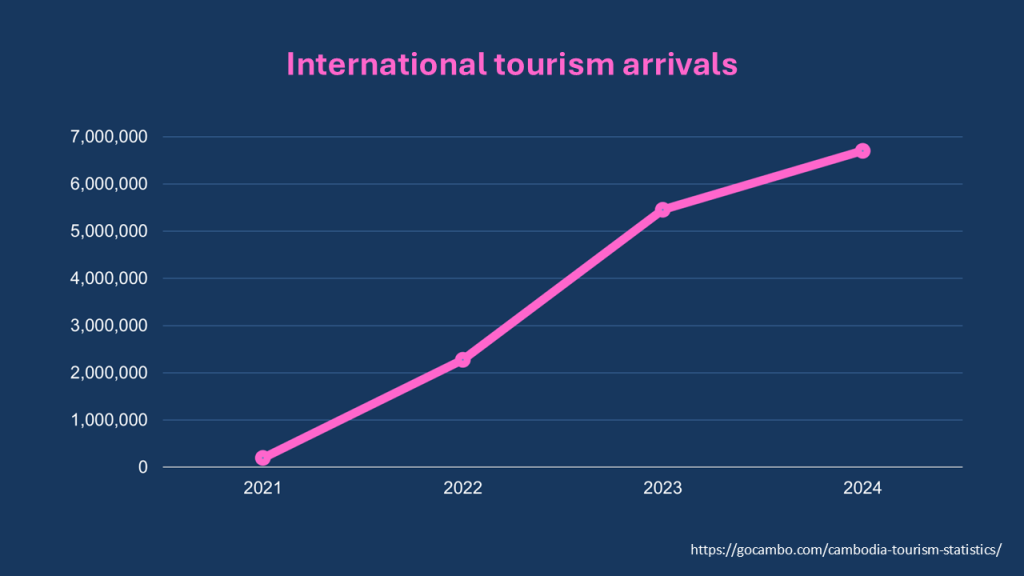
Cambodia’s tourism and hospitality sector has long been a cornerstone of its economy, offering millions of jobs and acting as a vital engine of growth [1]. In the wake of the COVID-19 pandemic, the industry’s impressive rebound has reignited hopes for widespread employment, especially among the country’s youth [2,3]. Figure 1 shows the sharp increase in tourist numbers with a notable post-pandemic rebound in 2022 that saw a 1058.6% increase in international arrivals. [4]
Figure 1: Increasing tourist numbers to Cambodia from 2021-2024 (adapted from https://gocambo.com/cambodia-tourism-statistics/)
Yet, beneath this promising recovery lies a persistent and troubling reality: women, who make up the majority of the tourism workforce, remain sidelined from its most rewarding opportunities. [5,6]
A promising model with proven results
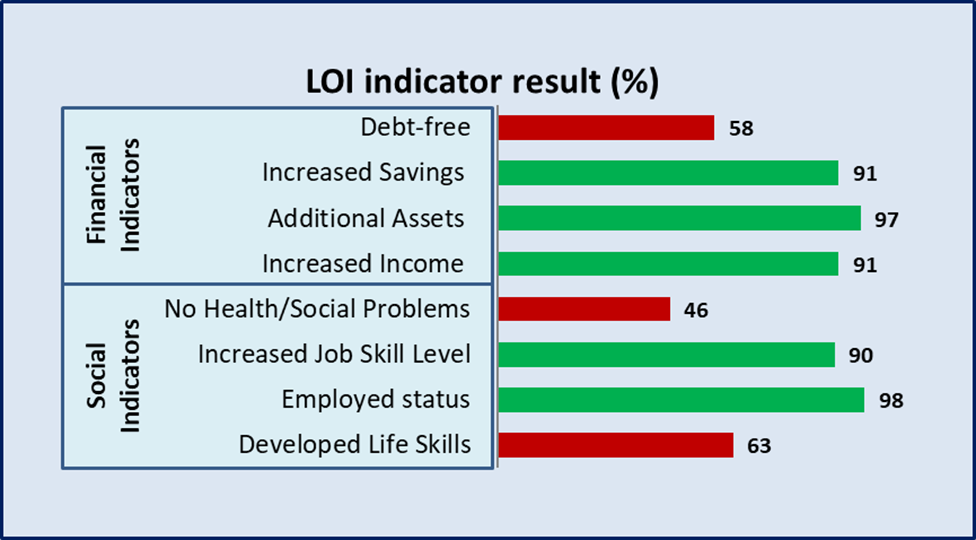
Recently, Rapid Universal examined the long-term outcomes of graduates from Sala Baï Hotel School, a non-profit hospitality training program based in Cambodia that serves disadvantaged youth, with a strong focus on supporting young women. The findings are striking. Before enrolling at Sala Baï, 80% of participants were unemployed, with many facing financial insecurity and limited prospects for advancement. Today, however, over 97% of graduates are employed, most in skilled roles within the hospitality sector. Figure 2 shows the Livelihood Outcome Index (LOI) that was used to measure the impact of the Sala Baï Hotel School program. The index is made up of four financial and four social indicators and outcomes are measured by examining which indicators improved as a result of the Sala Baï program. The results show that the majority of graduates were better-off in most of the indicators, and nearly all of them had increased savings, additional assets, increased income, increased job-skill level, and employed status.
Figure 2: Livelihood Outcome Index result
Graduates reported an average monthly income and benefits package of USD 950, which is significantly higher compared to Cambodia’s median monthly income. This jump in earnings does more than improve individual livelihoods; it creates a multiplier effect. Many alumni were found to support their families financially and help to pay for their siblings’ education, extending the benefits of vocational training across generations.
Empowerment beyond employment
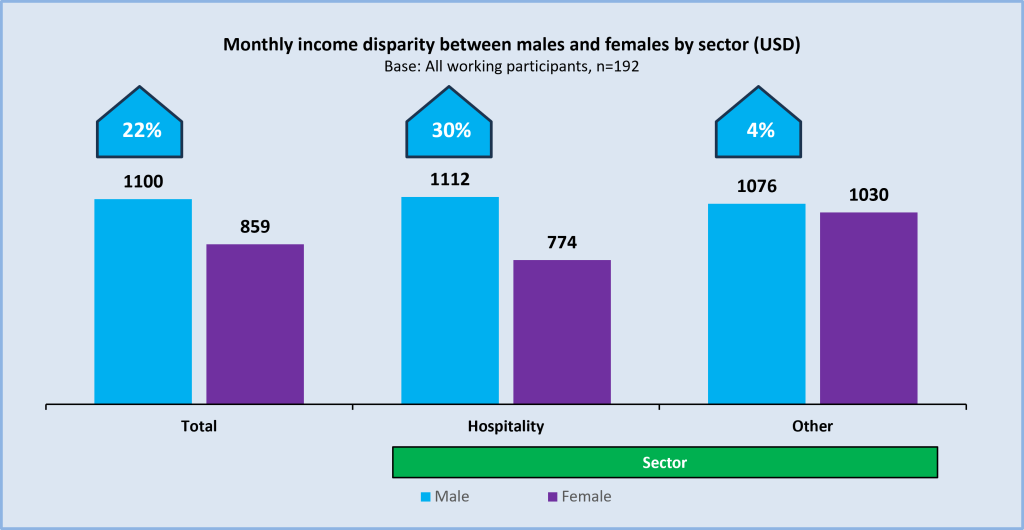
Beyond the financial gains, the impact assessment also revealed improvements in self-confidence, decision-making, and social mobility, particularly among women. For many female graduates, the program served as their first opportunity to live independently, manage their own finances, and take leadership roles in the workplace. This shift is especially important in a country where traditional gender norms can restrict women’s independence and career choices. However, while Sala Baï has created clear pathways to employment, challenges persist. Female graduates still earn, on average, 22% less than their male peers. Many also take on a disproportionate share of unpaid domestic responsibilities, which can limit their ability to advance professionally. These gendered dynamics are not unique to Sala Baï alumni; they reflect broader patterns across Cambodia’s labor market. Figure 3 below depicts the monthly income and benefits disparity between males and females by sector, with a notable difference in the hospitality sector
Figure 3: Differences in monthly income + benefits by sector, between males and females
A need for scalable, inclusive solutions
Sala Baï’s model, free, targeted training with wraparound support, has proven effective. But to truly close the gender gap in Cambodia’s tourism sector, such programs need to be scaled up and embedded within broader policy frameworks. This includes targeted outreach to young women, scholarships, career counseling, childcare support, and employer partnerships that prioritize gender equity.
National policies, such as the TVET Policy 2017–2025 and the Rectangular Strategy for Growth, already emphasize the importance of skills development and public–private collaboration. Our findings suggest that implementing these strategies with a strong gender lens could have powerful, long-term impacts, not just for individuals, but for Cambodia’s economic resilience as a whole.
Conclusion
As Cambodia’s tourism industry continues to rebound, the country has a unique opportunity to ‘build back better’ by being more inclusive and equitable. The story of Sala Baï alumni demonstrates what’s possible when marginalized youth, especially women, are given the chance to succeed. But progress must be intentional. To unlock the full potential of the sector, gender equity must be a cornerstone, not an afterthought of workforce development.
Bibliography
- The World Bank. Cambodia Poverty Assessment: Toward A More Inclusive and Resilient Cambodia. Washington, D.C.: World Bank; 2022.
- Cambodia Investment Review. Cambodia Hotel Association: Recovery in Sight Despite 93% Decline in Chinese Tourists and Reduced Air Travel Last Year [Internet]. 2024 [cited 2025 Jul 1]. Available from: https://cambodiainvestmentreview.com/2024/08/01/cambodia-hotel-association-recovery-in-sight-despite-93-decline-in-chinese-tourists-and-reduced-air-travel-last-year/
- Kiripost. Cambodia Welcomes 6.7M Tourists in 2024, Surpassing Pre-Pandemic Levels [Internet]. 2025 [cited 2025 Jul 1]. Available from: https://kiripost.com/stories/cambodia-welcomes-67m-tourists-in-2024-surpassing-pre-pandemic-levels
- GoCambo. Cambodia tourism statistics. [Internet]. [cited 2025 Oct 18]. Available from: https://gocambo.com/cambodia-tourism-statistics/
- Asian Development Bank. Sector Assessment Summary: Tourism in Cambodia, Community-Based Tourism COVID-19 Recovery Project. 2022.
- Government of Cambodia. Gender Equality and Women’s Empowerment in Cambodia. Phnom Penh: Ministry of Women’s Affairs; 2021.
Rapid Asia is highly committed to supporting sustainable and responsible business practices to make a difference in our society. If you found this article useful, please remember to ‘Like’ and share on social media, and hit the ‘Follow’ button, so you never miss an article.
About the authors: Daniel Lindgren is the Founder of Rapid Asia Co., Ltd., a management consultancy firm based in Bangkok that specialises in evaluations for programs, projects, social marketing campaigns, and other social development initiatives. Co-author, Sui Seng Ng, is a Project Assistant at Rapid Asia.