
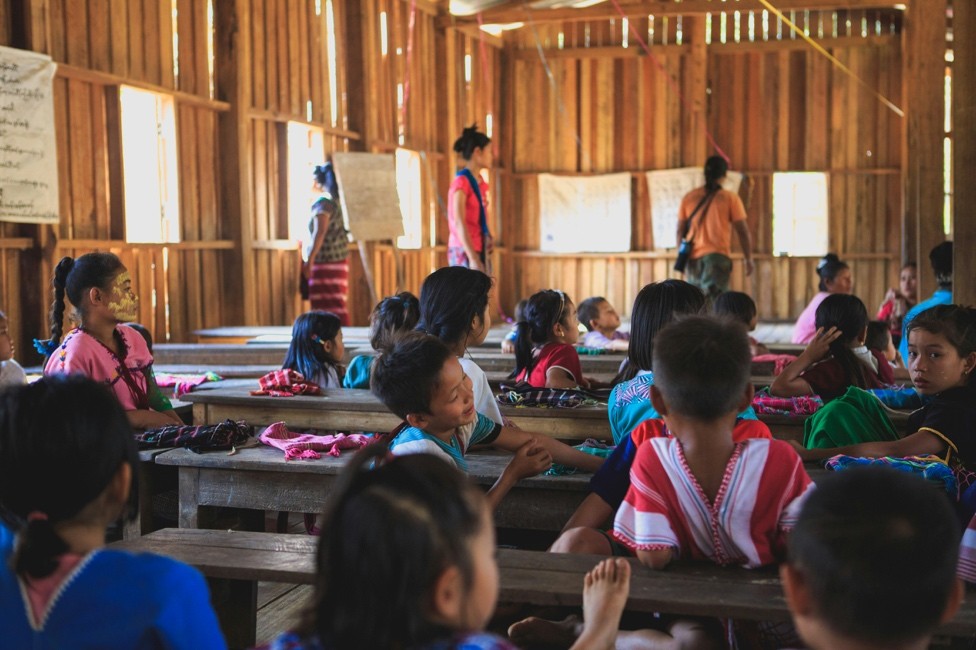
In the rugged highlands of Mae Hong Son, a Karen woman recalls her only classroom, a crumbling building used for informal education. With inconsistent teaching, her formal schooling ended at Grade 1; she learned little more than how to write her name. While wealthier peers moved to other districts to continue their studies, she was left behind. “I was so jealous of them,” she recalls. Her education was ultimately traded for labor.
“I cried and begged my mother to send me to school, but she told me we simply couldn’t afford it.”
More than a decade later, her experience reflects a broader pattern: for many Karen children in northern Thailand, access to education remains shaped by poverty, geography, and language barriers rather than ability or aspiration. [1]
The cost of poverty: A persistent cycle of inequality
Mae Hong Son has recorded Thailand’s highest proportion of extremely poor students for seven consecutive years. Currently, 45% of its students live in households earning under 3,000 THB ($85) monthly. [2] This constrains on access to education. While national primary enrollment is 89%, the rate for Northern Karen children is roughly 51%. Progression is even more limited: only one in four Karen students completes secondary school. [3] For subsistence-level families, indirect costs like transportation, meals, and uniforms are prohibitive. Consequently, education becomes a financial trade-off.
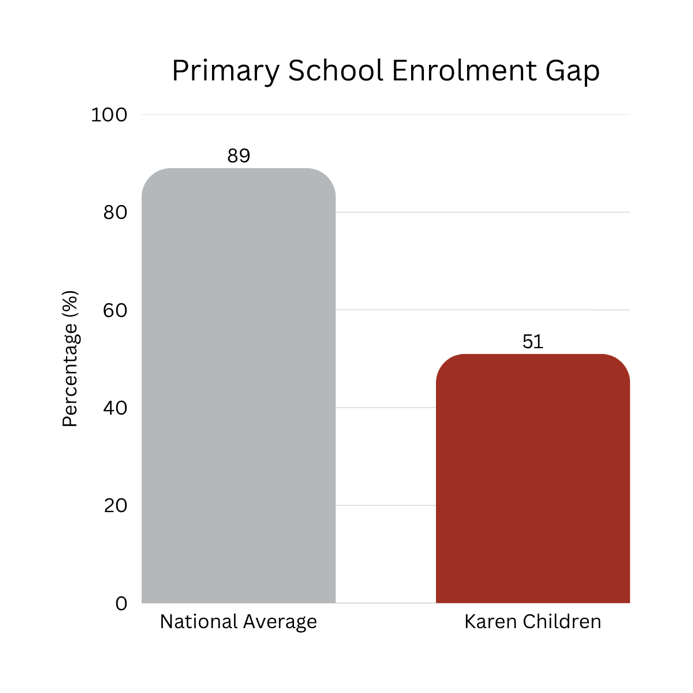
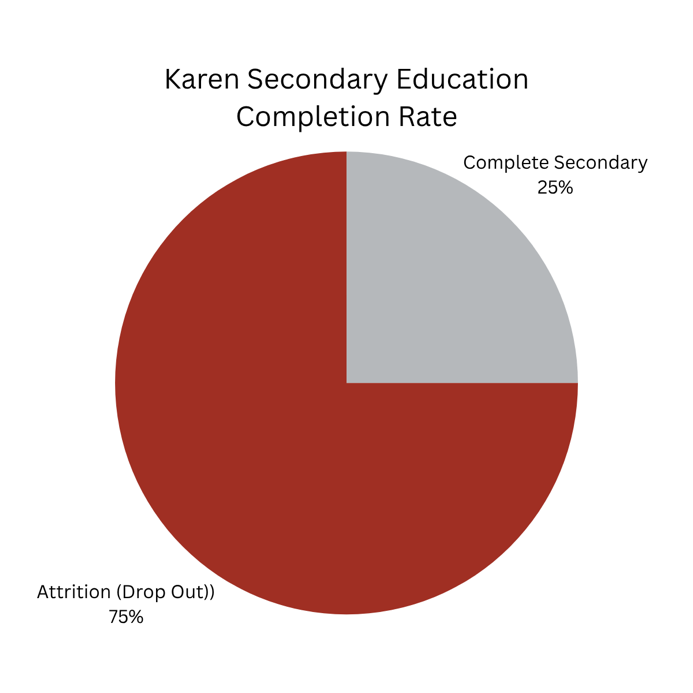
Figure 1: Primary School Enrolment Gap and Keran Secondary Education Completion Rate
Barriers beyond income: Geography and language
The geography of isolation: Mae Hong Son’s mountainous terrain presents a significant structural barrier. Many villages are accessible only via seasonal dirt roads, making daily travel to school difficult and unsafe, particularly during the rainy season. Furthermore, secondary schools are often located far from home, forcing students to either relocate or discontinue their education entirely. Access to nearby secondary education remains a critical unmet need.[5]
The linguistic barrier: Language presents another critical, yet overlooked, challenge. The national curriculum is delivered primarily in Thai, but many Karen children enter school speaking only their native language. This creates an immediate learning gap. Students struggle to understand instructions, to participate effectively, and to build confidence. Over time, this disconnect contributes to disengagement and higher dropout rates, driven not by a lack of ability but a lack of accessible instruction. [5]
Lessons from the region: Insight from Vietnam
Countries facing similar challenges have adopted targeted strategies to improve ethnic minority educational outcomes. Vietnam offers a valuable source of insight.
Linguistic inclusion: Vietnam implemented Mother Tongue-Based Multilingual Education (MTB-MLE) in selected regions, allowing children to learn in their native language during early primary years before transitioning to Vietnamese. This “bilingual bridge” improves comprehension, participation, and outcomes in foundational subjects. [6]
Structural support: To address geographic barriers, Vietnam invested in semi-boarding schools and provided incentives for remote teachers, reducing family burdens while improving teacher retention. [7]
Measured progress: These efforts contributed to significant enrollment and literacy gains, though disparities remain, underscoring the need for sustained interventions. [8]
The path forward: Toward practical educational equity
Achieving educational equity in Mae Hong Son requires moving toward targeted, implementable solutions. First, the government should expand transportation subsidies and school meal programs to reduce the financial burden on low-income families, directly improving attendance. Second, investment in local secondary schools and community dormitories is critical to reduce the need for long-distance travel, ensuring educational continuity. Third, the Ministry of Education should address teacher shortages by introducing incentives for highland educators, including hardship allowances and housing support. Finally, MTB-MLE pilot programs should be introduced in Karen communities, enabling students to build foundational skills in their native language before transitioning to Thai. Combining financial support, infrastructure investment, and inclusive pedagogy will help close the education gap, ensuring a child’s future is shaped by their potential, not by poverty or geography.
———-
Rapid Asia is highly committed to supporting sustainable and responsible business practices to make a difference in our society. If you found this article useful, please remember to ‘Like’ and share on social media, and hit the ‘Follow’ button on our LinkedIn page so you never miss an article.
This article was prepared by Akarawin Chintanasap, Project Assistant Intern.
References
[1] UNICEF Thailand. “Education for Ethnic Hill Tribe Children in Remote Area of Mae Hong Son.” YouTube video. June 29, 2011. Accessed April 24, 2026.https://www.youtube.com/watch?v=Un-MpHd08kg.
[2] “Mae Hong Son Leads Thailand’s Poorest Children List for Seventh Consecutive Year.” The Nation. September 13, 2025. Accessed April 24, 2026.https://www.nationthailand.com/news/general/40055378.
[3] Karen Hilltribes Trust. “Access to Quality Education.” Accessed April 24, 2026. https://karenhilltribes.org.uk/our-work/education/.
[4] Office of the Official Information Commission. “Provincial Development Plan and Geographic Constraints of Mae Hong Son Province.” Accessed April 24, 2026. https://www.oic.go.th/FILEWEB/CABINFOCENTER35/DRAWER005/GENERAL/DATA0000/00000022.PDF.
[5] Sudev, S. “Community Development and Education in Highland Areas.” Master’s thesis, Chiang Mai University, 2003. Chiang Mai University Digital Archive. Accessed April 24, 2026. https://archive.lib.cmu.ac.th/full/T/2003/sudev0503sr_ch2.pdf.
[6] Yen Tran Thi, Hanh Vuong, Van Pham Thi, Dung Dam Thi Hoai, Huong Ha Thanh, and Van Hoang Thi Ai. “A Model of Mother Tongue-Based Bilingual Education in Vietnam: Achievements and Lessons Learnt.” Journal for Educators, Teachers and Trainers 14, no. 6 (2023): 71–85. Accessed April 24, 2026. https://dialnet.unirioja.es/descarga/articulo/9216239.pdf.
[7] “Improving Education Quality in Ethnic Minority Areas.” Nhan Dan. September 3, 2024. Accessed April 24, 2026. https://en.nhandan.vn/improving-education-quality-in-ethnic-minority-areas-post139200.html.
[8] “Vietnam Makes Steady Strides in Eradicating Illiteracy Among Ethnic Minorities.” Vietnamnet Global. January 5, 2026. Accessed April 24, 2026. https://vietnamnet.vn/en/vietnam-makes-steady-strides-in-eradicating-illiteracy-among-ethnic-minorities-2478724.html.